


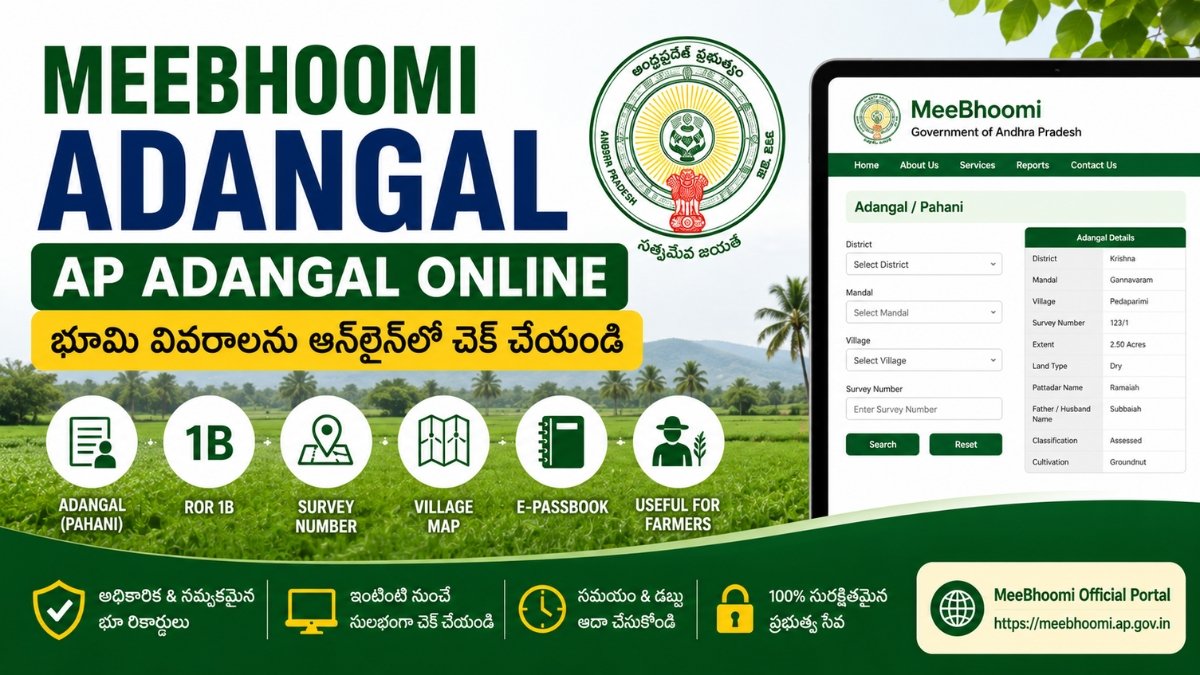
Adangal AP is an important revenue land record used in Andhra Pradesh to maintain information associated with agricultural land, cultivation and other applicable revenue particulars.
The Adangal is also commonly referred to as Pahani in land-record terminology. It can contain information relating to the landholder, land extent, cultivation, crops, possession-related entries, water details and other applicable revenue information.
For people researching Andhra Pradesh land records, Adangal is particularly useful when checking the agricultural and revenue-related history of a parcel of land. However, it should not be confused with ROR 1B, FMB, Village Map or E-Passbook, because each record serves a different purpose.
Official Andhra Pradesh government service documentation identifies Computerized Adangal as a Revenue service. Government service documentation also describes Adangal as containing information such as owner's details, area, assessment, water rate, soil type, possession, liabilities, tenancy and crops grown.
This guide explains Adangal AP, Adangal search, Adangal online, Adangal by Survey Number, Adangal download, Pahani, land details, cultivation information, Adangal and ROR 1B, Adangal and land ownership, corrections, official government services and frequently asked questions.
Important: MeeBhoomiAP.org is an independent informational website. It is not the official Government of Andhra Pradesh land-record portal.
What Is Adangal?
Adangal is a revenue record containing information relating to agricultural land and cultivation.
It is maintained within the Revenue administration and can provide information associated with a particular land parcel.
Depending on the record, Adangal may contain information relating to:
- Landholder/owner-related details
- Survey Number
- Land extent
- Land classification
- Cultivation
- Crops grown
- Possession-related information
- Soil type
- Water source/water rate
- Assessment
- Tenancy
- Liabilities
- Other applicable revenue particulars
The official government service description for Computerized Adangal specifically refers to owner's details, area, assessment, water rate, soil type, possession, liabilities, tenancy and crops.
What Is Pahani?
Pahani is a commonly used term associated with the Adangal land record.
In many land-record contexts, people use:
Adangal = Pahani
However, terminology can vary between states and government systems.
For Andhra Pradesh land-record searches, users commonly search for terms such as:
- Adangal
- Pahani
- Adangal Copy
- Computerized Adangal
- Adangal Online
Therefore, including these related search terms naturally in your content can help capture different search intents without keyword stuffing.
What Information Is Available in Adangal?
The exact fields can vary depending on the land record and current government system.
Common information associated with Adangal includes:
Land Details
- District
- Mandal
- Village
- Survey Number
- Sub-Division
- Extent
- Land classification
Cultivation Details
- Crop details
- Cultivation information
- Irrigation/water-related information
- Agricultural usage
Revenue Details
- Assessment
- Water rate
- Soil-related information
- Possession
- Tenancy
- Liabilities
The official AP government service documentation describes Computerized Adangal as containing several of these categories of information.
Why Is Adangal Important?
Adangal can be useful for understanding the revenue and cultivation-related history of agricultural land.
It can help users:
- Check agricultural land details
- Review cultivation-related information
- Verify survey and extent information
- Cross-check revenue records
- Understand crop-related entries
- Support certain land-related applications
- Compare information with ROR 1B
- Investigate discrepancies in land records
However, Adangal should be considered one part of the land-record verification process rather than the only document.
Adangal AP Online – Where to Check?
The official Andhra Pradesh land-record ecosystem includes MeeBhoomi, which is identified by AP district government websites as the state's online land-record portal.
Official MeeBhoomi Portal:
MeeBhoomi AP – Official Land Records Portal
The exact availability and interface of individual services can change, so users should verify the current official portal before searching or downloading a record.
How to Check Adangal Online in AP
A general process for checking available land records is:
Step 1: Open the Official Portal
Use the official MeeBhoomi portal.
Step 2: Select the Relevant Land-Record Service
Choose the applicable Adangal/land-record option.
Step 3: Enter Location Details
Depending on the current service, select:
- District
- Mandal
- Village
Step 4: Enter Land Details
You may need information such as:
- Survey Number
- Sub-Division
- Khata Number
- Other applicable reference
Step 5: Submit the Search
Enter the required details and proceed.
Step 6: Check the Record
Review the displayed Adangal information carefully.
Step 7: Cross-Check
Compare important details with your other land documents.
Adangal Search by Survey Number
The Survey Number is one of the most important references when identifying a particular parcel of land.
A typical search structure may involve:
District → Mandal → Village → Survey Number
If the survey number has a subdivision, make sure you select the correct subdivision.
For example, a land record could use a reference such as:
Survey No. 125/2
rather than simply:
Survey No. 125
This distinction can be important when checking the correct parcel.
Adangal by Khata Number
Depending on the service and current government system, land records may also be associated with a Khata Number.
If your documents contain a Khata Number, keep it available when searching for the relevant record.
However, do not assume that every online Adangal search interface supports every possible search method.
Always follow the fields available in the current official service.
Adangal Download AP
Many users search for:
“Adangal Download AP”
or
“Adangal PDF Download AP.”
The availability of a direct online download depends on the current government service and whether the relevant record is available digitally.
If a record can be downloaded or printed through the official service, use that facility.
For an official or certified copy required for an important transaction, application or legal matter, follow the prescribed government process instead of relying on a screenshot or unofficial PDF.
Is Adangal the Same as ROR 1B?
No.
Adangal and ROR 1B are different revenue records.
Adangal
Primarily contains information associated with:
- Cultivation
- Crops
- Possession
- Land use
- Revenue particulars
ROR 1B
Primarily relates to:
- Record of Rights
- Landholding information
- Khata
- Survey details
- Recorded holder-related information
The two records can complement each other during land-record verification.
Related Guide: ROR 1B AP
Is Adangal Proof of Land Ownership?
Adangal should not be treated by itself as conclusive proof of legal ownership or title.
It is a revenue record and may contain ownership/possession-related information, but legal title can depend on multiple documents and circumstances.
For ownership verification, consider reviewing:
- Registered Sale Deed
- Link Documents
- ROR 1B
- Adangal
- Mutation
- E-Passbook
- Survey Records
- Encumbrance-related records
- Court orders, where applicable
For high-value property transactions, professional title verification is recommended.
Adangal and Land Ownership
Adangal can contain owner-related information and other land particulars.
However, the information should be cross-checked against other records.
For example:
Adangal → Revenue/Cultivation Information
ROR 1B → Record of Rights
FMB → Survey/Measurement
Registered Deed → Registered Transaction Document
Mutation → Revenue Record Update
This distinction is important when explaining land records to users.
Adangal and ROR 1B – Difference
| Adangal | ROR 1B |
|---|---|
| Revenue/cultivation record | Record of Rights |
| Crop information may be included | Landholding-related information |
| Possession-related information may appear | Khata/holder-related information |
| Useful for agricultural information | Useful for rights/revenue information |
| Survey details may appear | Survey/extent details may appear |
Both can be useful when cross-checking land information.
Adangal and FMB – Difference
FMB = Field Measurement Book
FMB is primarily a survey record containing field measurement sketches.
Adangal = Revenue/Cultivation Record
Therefore:
FMB → Measurements & Survey
Adangal → Revenue & Cultivation
If your issue concerns the physical boundary of a property, FMB and other survey records may be more relevant than Adangal alone.
Adangal and Village Map – Difference
A Village Map provides broader cadastral/mapping information.
Adangal contains revenue/cultivation-related information.
Therefore:
- Adangal: land/revenue/cultivation information
- Village Map: broader spatial/map information
The AP Survey & Land Records Department maintains Village Maps and FMBs as part of its survey-record system.
Adangal and Mutation
Mutation relates to updating applicable revenue records following certain recognised transactions or changes.
For example:
- Sale
- Inheritance
- Partition
- Court order
- Other eligible changes
If a property was recently transferred, check whether the relevant mutation has been processed and whether the applicable land records have been updated.
If the old name continues to appear in the record, do not assume that Adangal alone can correct the issue.
Adangal and E-Passbook
Adangal and E-Passbook are separate services.
Adangal primarily provides revenue/cultivation-related information.
E-Passbook is associated with the electronic Pattadar Passbook service.
For property verification, the two can be reviewed alongside:
- ROR 1B
- Mutation
- Survey records
- Registered documents
Related Guide: E-Passbook Services AP
How to Verify Adangal Information
If you are using Adangal for property-related verification:
Check Survey Number
Make sure it matches your documents.
Check Land Extent
Compare the extent with ROR 1B and registered documents.
Check Village
Verify that the correct village has been selected.
Check Land Classification
Review the classification shown in the record.
Check Cultivation Details
If applicable, examine crop and cultivation-related entries.
Compare With ROR 1B
Look for major discrepancies.
Compare With Survey Records
For boundary or measurement matters, check FMB and Village Map.
What If Adangal Shows Wrong Information?
If the Adangal contains incorrect information:
1. Identify the Error
For example:
- Wrong name
- Wrong survey number
- Wrong extent
- Wrong cultivation information
- Incorrect classification
- Other revenue-record discrepancy
2. Compare Other Records
Check:
- ROR 1B
- Mutation
- FMB
- E-Passbook
- Registered documents
3. Contact the Appropriate Revenue Authority
Use the prescribed government correction process.
4. Keep Supporting Documents
Maintain copies of:
- Registered documents
- Previous revenue records
- Application acknowledgement
- Government correspondence
Do not attempt to alter the record through an unofficial website.
What If Adangal and ROR 1B Show Different Information?
A discrepancy between Adangal and ROR 1B should be investigated.
Possible reasons may include:
- Data-entry error
- Record update pending
- Mutation not reflected
- Survey revision
- Subdivision
- Different record-update dates
- Digitisation issues
Do not automatically conclude that one record is false.
Compare the underlying records and contact the appropriate Revenue authority where necessary.
What If Adangal Is Not Available Online?
Not every historical land record is necessarily available in the same digital format.
The AP Survey & Land Records Department notes that some historical survey records are old, damaged or unavailable and that digitisation status can vary.
If you cannot find an expected record:
- Verify District.
- Verify Mandal.
- Verify Village.
- Verify Survey Number.
- Check whether the record has been digitised.
- Contact the relevant Revenue office.
- Use the applicable government service for obtaining a copy.
Can I Get a Certified Adangal Copy?
The availability and procedure for certified copies depend on the current government service.
If you need the document for:
- Legal proceedings
- Property transaction
- Bank requirement
- Government application
- Court matter
use the applicable official government service and request the required type of copy.
A downloaded webpage or screenshot should not automatically be treated as a certified document.
Adangal for Agricultural Land
Adangal can be particularly useful for agricultural land because it can contain cultivation-related information.
Depending on the record, this may include:
- Crop details
- Cultivation
- Water-related information
- Soil information
- Possession
- Tenancy
The exact information depends on the particular record and government system.
Adangal for Land Purchase Verification
If you are considering purchasing agricultural land, Adangal can be one of the records to examine.
However, don't stop with Adangal.
A broader verification should include:
- Registered Sale Deed
- Link Documents
- ROR 1B
- Adangal
- Mutation
- E-Passbook
- FMB
- Village Map
- Encumbrance-related records
- Applicable legal/title verification
This helps reduce the risk of relying on a single record.
Adangal and Land Disputes
Adangal may be relevant in land disputes involving:
- Possession
- Cultivation
- Land use
- Survey details
- Revenue-record discrepancies
However, it does not automatically resolve a legal title dispute.
If the dispute concerns a boundary, official survey/demarcation may be required.
If the dispute concerns legal ownership, appropriate legal proceedings may be necessary.
Benefits of Checking Adangal Online
Checking available Adangal information online can help users:
- Review land details
- Check cultivation-related information
- Cross-check survey details
- Review revenue entries
- Compare land extent
- Identify discrepancies
- Support land-record verification
- Prepare for applicable government services
The exact online features depend on the current government system.
Important Tips Before Using Adangal
- Use the official MeeBhoomi portal.
- Verify the District, Mandal and Village.
- Check the exact Survey Number.
- Verify subdivision details.
- Compare Adangal with ROR 1B.
- Check mutation after property transactions.
- Use FMB for survey/measurement-related verification.
- Don't treat Adangal alone as title proof.
- Don't rely on unofficial PDFs.
- Keep certified copies for important legal matters.
- Consult a professional for title disputes.
Frequently Asked Questions
What is Adangal in Andhra Pradesh?
Adangal is an important revenue land record containing applicable information relating to land, cultivation and other revenue particulars.
Is Adangal also called Pahani?
Yes. Pahani is a commonly used term associated with Adangal in land-record terminology.
What information is available in Adangal?
Depending on the record, it may include landholder-related details, survey number, extent, classification, cultivation, crops, possession, soil, water, tenancy and other revenue particulars.
How can I check Adangal online in AP?
Use the official MeeBhoomi portal and select the applicable land-record/Adangal service available there.
Can I search Adangal by Survey Number?
The Survey Number is an important identifier for locating a land parcel. The exact search options depend on the current official service.
Can I search Adangal by Khata Number?
Availability depends on the current government search interface and record. Use the search fields provided by the official service.
Can I download Adangal online?
If the applicable official service provides a download or print facility, you can use it. Availability can vary by record.
Is Adangal free?
Do not assume that every Adangal-related service or certified copy is free. Verify the current government service and applicable charges before applying.
Is Adangal the same as ROR 1B?
No. Adangal and ROR 1B are different revenue records with different purposes.
Is Adangal proof of ownership?
No. Adangal should not independently be treated as conclusive proof of legal title.
What is the difference between Adangal and FMB?
Adangal primarily contains revenue/cultivation information, while FMB contains field measurement and survey-sketch information.
What is the difference between Adangal and Village Map?
Adangal provides revenue/cultivation information, while a Village Map provides broader spatial/cadastral mapping information.
Can Adangal show crop details?
Yes. Crop/cultivation information can be included in Adangal, depending on the applicable record.
Can Adangal show land extent?
Yes, land area/extent is among the information associated with the Computerized Adangal service.
What if my Adangal details are wrong?
Compare the entry with ROR 1B, mutation, registered documents and other records, then approach the appropriate Revenue authority for the applicable correction process.
What if Adangal and ROR 1B don't match?
Investigate the discrepancy by comparing the underlying records and checking whether a mutation, subdivision, revision or data-update issue is involved.
Can Adangal be used for a land dispute?
It can be a supporting revenue record, but it does not by itself resolve ownership or title disputes.
Can Adangal be used for buying land?
It can be useful as part of property due diligence, but it should never be the only document checked before purchasing land.
Is MeeBhoomiAP.org the official Adangal website?
No. MeeBhoomiAP.org is an independent informational website. The official MeeBhoomi portal is meebhoomi.ap.gov.in.
Where should I verify official Adangal information?
Use the official Andhra Pradesh government land-record services, particularly the official MeeBhoomi portal, and contact the concerned Revenue authority when an issue requires official verification.
Official Sources & References
MeeBhoomi AP
MeeBhoomi AP – Official Land Records Portal
AP Government Revenue Services
AP Revenue Services – Government of Andhra Pradesh
AP Government Survey & Land Records
AP Survey, Settlements & Land Records
AP Revenue Land Administration
AP Revenue Land Administration – Government of Andhra Pradesh
AP Government CSP User Manual
AP Government CSP User Manual – Revenue Services
Disclaimer
This article is provided for general informational and educational purposes only.
MeeBhoomiAP.org is an independent informational website and is not affiliated with, endorsed by, or operated by the Government of Andhra Pradesh, MeeBhoomi, MeeSeva, NIC, the Revenue Department or the Survey, Settlements & Land Records Department.
Government portals, procedures, services, fees, eligibility requirements and land-record availability may change. Always verify the latest information through the relevant official government portal or competent authority.
Adangal is a revenue record and should not individually be treated as conclusive proof of legal title or ownership. For property purchases, inheritance matters, land disputes or title verification, consult the appropriate government authority and, where necessary, a qualified legal professional.